


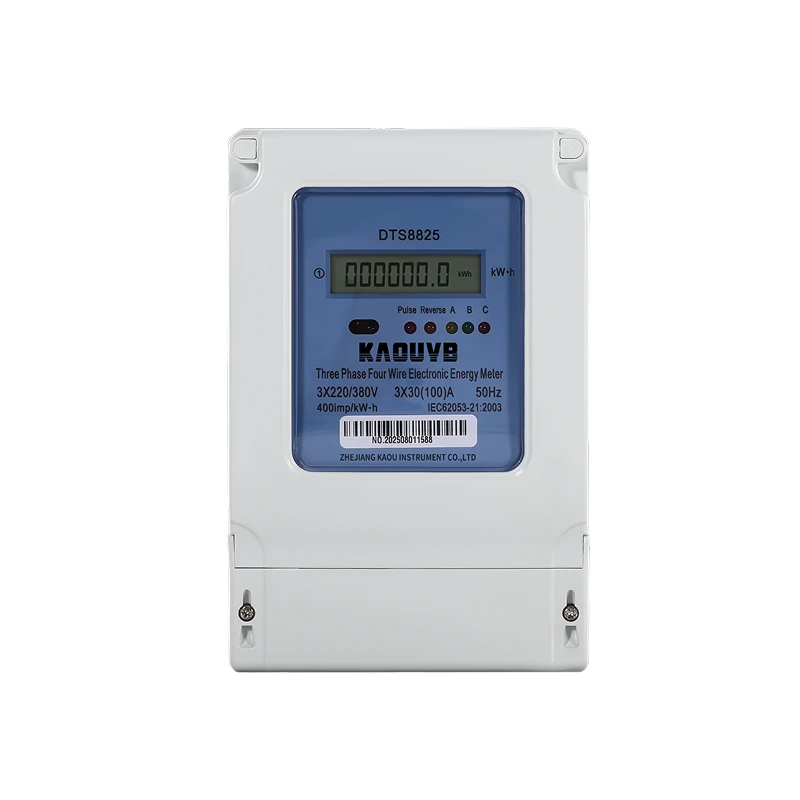
The 3 phase energy meter with rs485 is an intelligent metering device designed specifically for 220V/380V 50Hz three-phase AC scenarios. It adopts microelectronics technology and digital sampling processing solutions, integrating high-precision metering and convenient communication functions. The product supports multiple current ratings ranging from 1.5(6)A to 15(100)A, and can also be customized with parameters according to requirements.

Parameters & Specifications
|
Parameter |
Specification |
|
Voltage |
3×220/380V, 3×380V, 3×100V |
|
Frequency |
50Hz |
|
Accuracy Class |
1.0 or 2.0 |
|
Current Ratings |
3×1.5(6)A, 3×5(60)A, 3×15(100)A (*Customizable) |
|
Voltage Circuit Power |
≤1.0W 5VA (per phase) |
|
Current Circuit Power |
≤1VA (Ib per phase) |
|
Operating Temp. |
-15℃~+55℃ |
|
Storage/Transport Temp. |
-25℃~+70℃ |
Key Features
Measurement:
-Bidirectional active energy measurement (forward/reverse)
-Anti-tampering design (reverse-phase positive counting)
Display:
-High-quality mechanical counter or LCD (clear readability)
Indicators:
-LED pulse output (red) for energy measurement
-Reverse phase sequence indicator (optional)
Interfaces:
-Optically isolated passive pulse output (for calibration/data collection)
-RS485 protocols: DL/T645-97/07, MODBUS
Power Monitoring:
-ABC phase voltage indicators (lights off = phase loss)

Reasons To Choose 3 Phase Energy Meter With Rs485
Remote Data Collection: No on-site manual meter reading required; remote reading of energy data via RS485 communication reduces labor costs and avoids human errors
Centralized Data Management: Multiple meters can be connected to the same monitoring system for centralized storage, analysis and statistics of energy data
High Stability&Anti-Interference: RS485 communication has differential transmission characteristics, strong anti-interference ability, suitable for complex electromagnetic environments such as industry and commerce
Flexible Parameter Configuration: Communication parameters such as meter address and baud rate can be modified remotely without on-site operation, improving maintenance efficiency

FAQ


